- Get link
- X
- Other Apps
• Temperatures drop below -15°C in the region in wake of snowfall
• Residents protest against prolonged power outages
GILGIT / ISLAMABAD: The difficulties of Gilgit-Baltistan residents intensified on Wednesday as snowfall disconnected road access to remote areas, with temperatures dropping below minus 15 degrees Celsius in the region. As freezing temperatures persisted, people took to the streets to protest prolonged power outages.
A patient in Astore allegedly died due to the unavailability of transportation facilities for treatment.
A fresh spell of snowfall on Monday and Tuesday brought life to a standstill across parts of GB amid freezing temperatures, power outages and road closures. The suffering of residents due to snow, harsh weather, lack of electricity and other basic facilities continued in remote areas on Wednesday.
Police said up to six inches of snow was recorded in parts of Skardu, Astore, Ghanche, Shigar, Kharmang, Hunza, Nagar and Ghizer, disrupting routine life and making travel hazardous.
Locals said a patient from the Mirmalik area of Astore was being shifted on foot to Rattu hospital after roads were blocked by snowfall, but he died before reaching the hospital.
According to a statement issued by the Astore assistant commissioner, locals attempted to shift a patient from Chamriot to a nearby hospital.
Following the information, a rescue team comprising the Astore Disaster Management District assistant director, two doctors and a snow-cutter machine was dispatched. The team reached Dadujil after clearing the road, but doctors confirmed that the patient had died four to five hours earlier.
Officials of the GB Communications and Works Department said the Karakoram Highway, Ghizer-Shandur road, Astore Valley road and Baltistan road were opened for traffic in the evening.
Travellers were advised to exercise caution as snowfall had made roads slippery and hazardous.
Confined to homes
Residents in remote areas remained confined to their homes due to blocked roads, freezing temperatures and unavailability of electricity and firewood.
Shafqat Hussain, a resident of Astore, said there was fear of food shortages in snow-hit areas if roads were not opened urgently.
Upper areas of Skardu, Ghanche, Ghizer, Hunza, Nagar and Shigar were also facing communication disruptions, road closures and electricity shortages.
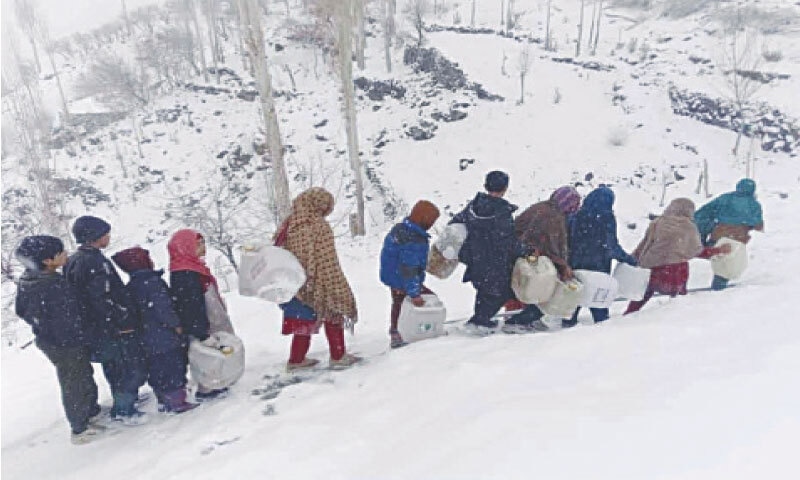
Residents were facing water shortage as pipelines and streams froze, forcing people, particularly women, to fetch water from distant places.
In the border area of Dansar Thang in Kharmang district, heavy snowfall created a severe drinking water crisis. Locals said women were forced to fetch water from dangerous mountain routes four kilometres away. They demanded emergency provision of clean drinking water and basic health facilities.
Residents in the Nilt area of Nagar district staged a protest by blocking the Karakoram Highway for several hours.
Protesters said the area had been without electricity for several days. They added that residents already faced daily power outages of up to 20 hours, but electricity had been completely unavailable for the last few days.
Similar demonstrations were held in Gilgit’s Basin area, as well as in Ghanche, Ghizer and Diamer.
The Provincial Emergency Operation Centre, GB, issued an alert warning of widespread rain, thunderstorms and snowfall from Jan 30 to Feb 2. It cautioned about extremely cold temperatures, avalanche risks, landslides, road closures and hazardous travel conditions, advising residents to remain alert and travellers to avoid non-essential travel during heavy snowfall.
Meanwhile, temperatures in major urban centres of the country varied on Wednesday morning. Islamabad and Peshawar recorded five degrees Celsius, while Lahore was at 10 degrees.
In the south, Karachi’s temperature was 12 degrees Celsius. Colder conditions prevailed in northern areas, with Quetta recording minus five degrees Celsius, Murree minus one and Muzaffarabad zero degrees Celsius.
With input from PPI
Published in Dawn, January 29th, 2026
from Dawn - Home https://ift.tt/5ptwMi0